\[\newcommand{\N}{\mathbb N}
\newcommand{\Z}{\mathbb Z}
\newcommand{\Q}{\mathbb Q}
\newcommand{\R}{\mathbb R}
\newcommand{\C}{\mathbb C}
\newcommand{\ba}{\mathbf{a}}
\newcommand{\bb}{\mathbf{b}}
\newcommand{\bc}{\mathbf{c}}
\newcommand{\bd}{\mathbf{d}}
\newcommand{\be}{\mathbf{e}}
\newcommand{\bff}{\mathbf{f}}
\newcommand{\bh}{\mathbf{h}}
\newcommand{\bi}{\mathbf{i}}
\newcommand{\bj}{\mathbf{j}}
\newcommand{\bk}{\mathbf{k}}
\newcommand{\bN}{\mathbf{N}}
\newcommand{\bn}{\mathbf{n}}
\newcommand{\bo}{\mathbf{0}}
\newcommand{\bp}{\mathbf{p}}
\newcommand{\bq}{\mathbf{q}}
\newcommand{\br}{\mathbf{r}}
\newcommand{\bs}{\mathbf{s}}
\newcommand{\bT}{\mathbf{T}}
\newcommand{\bu}{\mathbf{u}}
\newcommand{\bv}{\mathbf{v}}
\newcommand{\bw}{\mathbf{w}}
\newcommand{\bx}{\mathbf{x}}
\newcommand{\by}{\mathbf{y}}
\newcommand{\bz}{\mathbf{z}}
\newcommand{\bzero}{\mathbf{0}}
\newcommand{\nv}{\mathbf{0}}
\newcommand{\cA}{\mathcal{A}}
\newcommand{\cB}{\mathcal{B}}
\newcommand{\cC}{\mathcal{C}}
\newcommand{\cD}{\mathcal{D}}
\newcommand{\cE}{\mathcal{E}}
\newcommand{\cF}{\mathcal{F}}
\newcommand{\cG}{\mathcal{G}}
\newcommand{\cH}{\mathcal{H}}
\newcommand{\cI}{\mathcal{I}}
\newcommand{\cJ}{\mathcal{J}}
\newcommand{\cK}{\mathcal{K}}
\newcommand{\cL}{\mathcal{L}}
\newcommand{\cM}{\mathcal{M}}
\newcommand{\cN}{\mathcal{N}}
\newcommand{\cO}{\mathcal{O}}
\newcommand{\cP}{\mathcal{P}}
\newcommand{\cQ}{\mathcal{Q}}
\newcommand{\cR}{\mathcal{R}}
\newcommand{\cS}{\mathcal{S}}
\newcommand{\cT}{\mathcal{T}}
\newcommand{\cU}{\mathcal{U}}
\newcommand{\cV}{\mathcal{V}}
\newcommand{\cW}{\mathcal{W}}
\newcommand{\cX}{\mathcal{X}}
\newcommand{\cY}{\mathcal{Y}}
\newcommand{\cZ}{\mathcal{Z}}
\newcommand{\rA}{\mathrm{A}}
\newcommand{\rB}{\mathrm{B}}
\newcommand{\rC}{\mathrm{C}}
\newcommand{\rD}{\mathrm{D}}
\newcommand{\rE}{\mathrm{E}}
\newcommand{\rF}{\mathrm{F}}
\newcommand{\rG}{\mathrm{G}}
\newcommand{\rH}{\mathrm{H}}
\newcommand{\rI}{\mathrm{I}}
\newcommand{\rJ}{\mathrm{J}}
\newcommand{\rK}{\mathrm{K}}
\newcommand{\rL}{\mathrm{L}}
\newcommand{\rM}{\mathrm{M}}
\newcommand{\rN}{\mathrm{N}}
\newcommand{\rO}{\mathrm{O}}
\newcommand{\rP}{\mathrm{P}}
\newcommand{\rQ}{\mathrm{Q}}
\newcommand{\rR}{\mathrm{R}}
\newcommand{\rS}{\mathrm{S}}
\newcommand{\rT}{\mathrm{T}}
\newcommand{\rU}{\mathrm{U}}
\newcommand{\rV}{\mathrm{V}}
\newcommand{\rW}{\mathrm{W}}
\newcommand{\rX}{\mathrm{X}}
\newcommand{\rY}{\mathrm{Y}}
\newcommand{\rZ}{\mathrm{Z}}
\newcommand{\pv}{\overline}
\newcommand{\iu}{\mathrm{i}}
\newcommand{\ju}{\mathrm{j}}
\newcommand{\im}{\mathrm{i}}
\newcommand{\e}{\mathrm{e}}
\newcommand{\real}{\operatorname{Re}}
\newcommand{\imag}{\operatorname{Im}}
\newcommand{\Arg}{\operatorname{Arg}}
\newcommand{\Ln}{\operatorname{Ln}}
\DeclareMathOperator*{\res}{res}
\newcommand{\re}{\operatorname{Re}}
\newcommand{\im}{\operatorname{Im}}
\newcommand{\arsinh}{\operatorname{ar\,sinh}}
\newcommand{\arcosh}{\operatorname{ar\,cosh}}
\newcommand{\artanh}{\operatorname{ar\,tanh}}
\newcommand{\sgn}{\operatorname{sgn}}
\newcommand{\diag}{\operatorname{diag}}
\newcommand{\proj}{\operatorname{proj}}
\newcommand{\rref}{\operatorname{rref}}
\newcommand{\rank}{\operatorname{rank}}
\newcommand{\Span}{\operatorname{span}}
\newcommand{\vir}{\operatorname{span}}
\renewcommand{\dim}{\operatorname{dim}}
\newcommand{\alg}{\operatorname{alg}}
\newcommand{\geom}{\operatorname{geom}}
\newcommand{\id}{\operatorname{id}}
\newcommand{\norm}[1]{\lVert #1 \rVert}
\newcommand{\tp}[1]{#1^{\top}}
\renewcommand{\d}{\mathrm{d}}
\newcommand{\sij}[2]{\bigg/_{\mspace{-15mu}#1}^{\,#2}}
\newcommand{\abs}[1]{\lvert#1\rvert}
\newcommand{\pysty}[1]{\left[\begin{array}{@{}r@{}}#1\end{array}\right]}
\newcommand{\piste}{\cdot}
\newcommand{\qedhere}{}
\newcommand{\taumatrix}[1]{\left[\!\!#1\!\!\right]}
\newenvironment{augmatrix}[1]{\left[\begin{array}{#1}}{\end{array}\right]}
\newenvironment{vaugmatrix}[1]{\left|\begin{array}{#1}}{\end{array}\right|}
\newcommand{\trans}{\mathrm{T}}
\newcommand{\EUR}{\text{\unicode{0x20AC}}}
\newcommand{\SI}[3][]{#2\,\mathrm{#3}}
\newcommand{\si}[2][]{\mathrm{#2}}
\newcommand{\num}[2][]{#2}
\newcommand{\ang}[2][]{#2^{\circ}}
\newcommand{\meter}{m}
\newcommand{\metre}{\meter}
\newcommand{\kilo}{k}
\newcommand{\kilogram}{kg}
\newcommand{\gram}{g}
\newcommand{\squared}{^2}
\newcommand{\cubed}{^3}
\newcommand{\minute}{min}
\newcommand{\hour}{h}
\newcommand{\second}{s}
\newcommand{\degreeCelsius}{^{\circ}C}
\newcommand{\per}{/}
\newcommand{\centi}{c}
\newcommand{\milli}{m}
\newcommand{\deci}{d}
\newcommand{\percent}{\%}
\newcommand{\Var}{\operatorname{Var}}
\newcommand{\Cov}{\operatorname{Cov}}
\newcommand{\Corr}{\operatorname{Corr}}
\newcommand{\Tasd}{\operatorname{Tasd}}
\newcommand{\Ber}{\operatorname{Ber}}
\newcommand{\Bin}{\operatorname{Bin}}
\newcommand{\Geom}{\operatorname{Geom}}
\newcommand{\Poi}{\operatorname{Poi}}
\newcommand{\Hyperg}{\operatorname{Hyperg}}
\newcommand{\Tas}{\operatorname{Tas}}
\newcommand{\Exp}{\operatorname{Exp}}
\newcommand{\tdist}{\operatorname{t}}
\newcommand{\rd}{\mathrm{d}}
\newcommand{\oiint}{\unicode{x222F}}\]
Painopiste ja keskiö
Painopistekaavan perustelu on luontevinta tehdä tasointegraalille, vaikka
painopisteen ja keskiön käsitteet on määritelty myös avaruusintegraalille sekä viiva- ja pintaintegraaleille.
Syy on se, että 2-ulotteinen ”levy” voidaan usein tukea painopisteen
kohdalta niin, että se pysyy tasapainossa, mutta 3-ulotteisen kappaleen
painopiste on yleensä kappaleen sisällä ja käyrien ja pintojen tapauksessa
niiden ulkopuolella.
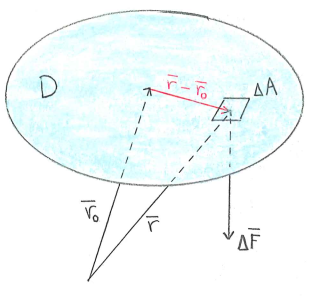
Tarkastellaan siis rajoitettua tasoaluetta \(D\), joka on sijoitettu
3-ulotteiseen avaruuteen jollekin tasolle \(z=z_0=\) vakio. Kiinnitetään
joukon \(D\) piste \(\mathbf{r}_0=x_0\mathbf{i}+y_0\mathbf{j}+z_0\mathbf{k}\) ja
lasketaan joukon \(D\) aiheuttama
kokonaismomentti tämän pisteen suhteen, kun pintatiheys
\(\sigma\colon D\to [0,\infty[\) voi vaihdella (tai on vakio). Pienen
suorakulmaisen ruudun massa on muotoa \(\Delta m\approx \sigma(\mathbf{r}) \Delta A\),
kun pintatiheys lasketaan (esimerkiksi) ruudun keskipisteessä
\(\mathbf{r}=x\mathbf{i}+y\mathbf{j}+z_0\mathbf{k}\).
Tähän ruutuun kohdistuva painovoima on muotoa
\(\Delta \mathbf{F}\approx -g \Delta m\mathbf{k}\).
Lukiofysiikan kaavan
\[\text{momentti} = \text{voima} \cdot \text{varsi}\]
vektorimuoto on
\[\mathbf{M} = \mathbf{r}\times \mathbf{F}.\]
Koska \(\bi \times\bk =-\bj\) ja \(\bj \times \bk = \bi\), niin
pienen ruudun aiheuttama momentti tukipisteen suhteen saadaan muotoon
\[\begin{split}\begin{array}{rcl}
\Delta \mathbf{M} &=& (\mathbf{r}-\mathbf{r}_0)\times \Delta \mathbf{F}
= -g\Delta m (\mathbf{r}-\mathbf{r}_0)\times \mathbf{k}\nonumber\\
&=& -\sigma (\mathbf{r})g\Delta A \big( (x-x_0)\mathbf{i}+(y-y_0)\mathbf{j}\big)\times \mathbf{k}
\nonumber\\
&=& -\sigma (\mathbf{r})g\Delta A \big(-(x-x_0)\mathbf{j}+(y-y_0)\mathbf{i}\big).\nonumber
\end{array}\end{split}\]
Kokonaismomentti pisteen \(\mathbf{r}_0\) suhteen saadaan laskemalla yhteen kaikki ruudut
ja tihentämällä jakoa, jolloin summa lähestyy tasointegraalia ja momentiksi saadaan
\[\Sigma \Delta \mathbf{M} \to \mathbf{M} =
g\left(\iint_D (x-x_0)\sigma(x,y)\, dA\right)\mathbf{j}-
g\left(\iint_D (y-y_0)\sigma(x,y)\, dA\right)\mathbf{i}.\]
Tasapainossa \(\mathbf{M}=\mathbf{0}\), joten
\[\iint_D (x-x_0)\sigma(x,y)\, dA= \iint_D (y-y_0)\sigma(x,y)\, dA = 0.\]
Tässä
\[\begin{split}\begin{array}{rcl}
0 &=&\iint_D (x-x_0)\sigma(x,y)\, dA = \iint_D x\sigma(x,y)\, dA-\iint_D x_0\sigma(x,y)\, dA
\nonumber\\
&=& \iint_D x\sigma(x,y)\, dA -x_0 \underbrace{\iint_D \sigma(x,y)\, dA}_{=m},\nonumber
\end{array}\end{split}\]
joten
\[x_0 =\frac{1}{m}\iint_D x\sigma(x,y)\, dA\]
ja toisesta yhtälöstä saadaan samalla tavalla
\[y_0 =\frac{1}{m}\iint_D y\sigma(x,y)\, dA.\]
Nämä ovat siis painopisteen koordinaatit.
Jos \(\sigma\) on vakio, niin \(m=\sigma A\) ja pintatiheys supistuu kaavoista pois.
Näin saadaan joukon \(D\) keskiön (= matemaattinen keskipiste) koordinaatit
\[\overline{x}=\frac{1}{A}\iint_D x\, dA, \ \overline{y}=\frac{1}{A}\iint_D y\, dA.\]
Ne ovat siis koordinaattifunktioiden \(x\) ja \(y\) keskiarvoja joukossa \(D\).