\[\newcommand{\N}{\mathbb N}
\newcommand{\Z}{\mathbb Z}
\newcommand{\Q}{\mathbb Q}
\newcommand{\R}{\mathbb R}
\newcommand{\C}{\mathbb C}
\newcommand{\ba}{\mathbf{a}}
\newcommand{\bb}{\mathbf{b}}
\newcommand{\bc}{\mathbf{c}}
\newcommand{\bd}{\mathbf{d}}
\newcommand{\be}{\mathbf{e}}
\newcommand{\bff}{\mathbf{f}}
\newcommand{\bh}{\mathbf{h}}
\newcommand{\bi}{\mathbf{i}}
\newcommand{\bj}{\mathbf{j}}
\newcommand{\bk}{\mathbf{k}}
\newcommand{\bN}{\mathbf{N}}
\newcommand{\bn}{\mathbf{n}}
\newcommand{\bo}{\mathbf{0}}
\newcommand{\bp}{\mathbf{p}}
\newcommand{\bq}{\mathbf{q}}
\newcommand{\br}{\mathbf{r}}
\newcommand{\bs}{\mathbf{s}}
\newcommand{\bT}{\mathbf{T}}
\newcommand{\bu}{\mathbf{u}}
\newcommand{\bv}{\mathbf{v}}
\newcommand{\bw}{\mathbf{w}}
\newcommand{\bx}{\mathbf{x}}
\newcommand{\by}{\mathbf{y}}
\newcommand{\bz}{\mathbf{z}}
\newcommand{\bzero}{\mathbf{0}}
\newcommand{\nv}{\mathbf{0}}
\newcommand{\cA}{\mathcal{A}}
\newcommand{\cB}{\mathcal{B}}
\newcommand{\cC}{\mathcal{C}}
\newcommand{\cD}{\mathcal{D}}
\newcommand{\cE}{\mathcal{E}}
\newcommand{\cF}{\mathcal{F}}
\newcommand{\cG}{\mathcal{G}}
\newcommand{\cH}{\mathcal{H}}
\newcommand{\cI}{\mathcal{I}}
\newcommand{\cJ}{\mathcal{J}}
\newcommand{\cK}{\mathcal{K}}
\newcommand{\cL}{\mathcal{L}}
\newcommand{\cM}{\mathcal{M}}
\newcommand{\cN}{\mathcal{N}}
\newcommand{\cO}{\mathcal{O}}
\newcommand{\cP}{\mathcal{P}}
\newcommand{\cQ}{\mathcal{Q}}
\newcommand{\cR}{\mathcal{R}}
\newcommand{\cS}{\mathcal{S}}
\newcommand{\cT}{\mathcal{T}}
\newcommand{\cU}{\mathcal{U}}
\newcommand{\cV}{\mathcal{V}}
\newcommand{\cW}{\mathcal{W}}
\newcommand{\cX}{\mathcal{X}}
\newcommand{\cY}{\mathcal{Y}}
\newcommand{\cZ}{\mathcal{Z}}
\newcommand{\rA}{\mathrm{A}}
\newcommand{\rB}{\mathrm{B}}
\newcommand{\rC}{\mathrm{C}}
\newcommand{\rD}{\mathrm{D}}
\newcommand{\rE}{\mathrm{E}}
\newcommand{\rF}{\mathrm{F}}
\newcommand{\rG}{\mathrm{G}}
\newcommand{\rH}{\mathrm{H}}
\newcommand{\rI}{\mathrm{I}}
\newcommand{\rJ}{\mathrm{J}}
\newcommand{\rK}{\mathrm{K}}
\newcommand{\rL}{\mathrm{L}}
\newcommand{\rM}{\mathrm{M}}
\newcommand{\rN}{\mathrm{N}}
\newcommand{\rO}{\mathrm{O}}
\newcommand{\rP}{\mathrm{P}}
\newcommand{\rQ}{\mathrm{Q}}
\newcommand{\rR}{\mathrm{R}}
\newcommand{\rS}{\mathrm{S}}
\newcommand{\rT}{\mathrm{T}}
\newcommand{\rU}{\mathrm{U}}
\newcommand{\rV}{\mathrm{V}}
\newcommand{\rW}{\mathrm{W}}
\newcommand{\rX}{\mathrm{X}}
\newcommand{\rY}{\mathrm{Y}}
\newcommand{\rZ}{\mathrm{Z}}
\newcommand{\pv}{\overline}
\newcommand{\iu}{\mathrm{i}}
\newcommand{\ju}{\mathrm{j}}
\newcommand{\im}{\mathrm{i}}
\newcommand{\e}{\mathrm{e}}
\newcommand{\real}{\operatorname{Re}}
\newcommand{\imag}{\operatorname{Im}}
\newcommand{\Arg}{\operatorname{Arg}}
\newcommand{\Ln}{\operatorname{Ln}}
\DeclareMathOperator*{\res}{res}
\newcommand{\re}{\operatorname{Re}}
\newcommand{\im}{\operatorname{Im}}
\newcommand{\arsinh}{\operatorname{ar\,sinh}}
\newcommand{\arcosh}{\operatorname{ar\,cosh}}
\newcommand{\artanh}{\operatorname{ar\,tanh}}
\newcommand{\sgn}{\operatorname{sgn}}
\newcommand{\diag}{\operatorname{diag}}
\newcommand{\proj}{\operatorname{proj}}
\newcommand{\rref}{\operatorname{rref}}
\newcommand{\rank}{\operatorname{rank}}
\newcommand{\Span}{\operatorname{span}}
\newcommand{\vir}{\operatorname{span}}
\renewcommand{\dim}{\operatorname{dim}}
\newcommand{\alg}{\operatorname{alg}}
\newcommand{\geom}{\operatorname{geom}}
\newcommand{\id}{\operatorname{id}}
\newcommand{\norm}[1]{\lVert #1 \rVert}
\newcommand{\tp}[1]{#1^{\top}}
\renewcommand{\d}{\mathrm{d}}
\newcommand{\sij}[2]{\bigg/_{\mspace{-15mu}#1}^{\,#2}}
\newcommand{\abs}[1]{\lvert#1\rvert}
\newcommand{\pysty}[1]{\left[\begin{array}{@{}r@{}}#1\end{array}\right]}
\newcommand{\piste}{\cdot}
\newcommand{\qedhere}{}
\newcommand{\taumatrix}[1]{\left[\!\!#1\!\!\right]}
\newenvironment{augmatrix}[1]{\left[\begin{array}{#1}}{\end{array}\right]}
\newenvironment{vaugmatrix}[1]{\left|\begin{array}{#1}}{\end{array}\right|}
\newcommand{\trans}{\mathrm{T}}
\newcommand{\EUR}{\text{\unicode{0x20AC}}}
\newcommand{\SI}[3][]{#2\,\mathrm{#3}}
\newcommand{\si}[2][]{\mathrm{#2}}
\newcommand{\num}[2][]{#2}
\newcommand{\ang}[2][]{#2^{\circ}}
\newcommand{\meter}{m}
\newcommand{\metre}{\meter}
\newcommand{\kilo}{k}
\newcommand{\kilogram}{kg}
\newcommand{\gram}{g}
\newcommand{\squared}{^2}
\newcommand{\cubed}{^3}
\newcommand{\minute}{min}
\newcommand{\hour}{h}
\newcommand{\second}{s}
\newcommand{\degreeCelsius}{^{\circ}C}
\newcommand{\per}{/}
\newcommand{\centi}{c}
\newcommand{\milli}{m}
\newcommand{\deci}{d}
\newcommand{\percent}{\%}
\newcommand{\Var}{\operatorname{Var}}
\newcommand{\Cov}{\operatorname{Cov}}
\newcommand{\Corr}{\operatorname{Corr}}
\newcommand{\Tasd}{\operatorname{Tasd}}
\newcommand{\Ber}{\operatorname{Ber}}
\newcommand{\Bin}{\operatorname{Bin}}
\newcommand{\Geom}{\operatorname{Geom}}
\newcommand{\Poi}{\operatorname{Poi}}
\newcommand{\Hyperg}{\operatorname{Hyperg}}
\newcommand{\Tas}{\operatorname{Tas}}
\newcommand{\Exp}{\operatorname{Exp}}
\newcommand{\tdist}{\operatorname{t}}
\newcommand{\rd}{\mathrm{d}}
\newcommand{\oiint}{\unicode{x222F}}\]
Keskiarvoja käyrillä
Tarkastellaan vielä luvun lopuksi funktion keskiarvon laskemista. Kuten kaikissa muissakin
integraaleissa, keskiarvo määritellään jakamalla funktion integraali joukon ”mitalla”.
Esimerkki 3.2.1
Laske paraabelin \(y=x^2\), \(-2\le x \le 2\),
keskikaarevuus;
keskikaarevuussäde.
Suoraviivaisin paraabelin parametrisointi on muotoa \(x=t,\ y=t^2\), \(t\in [-2,2]\).
Tällöin \(\br'(t)=\bi+2t\bj\) ja \(\|\br'(t)\|=\sqrt{1+4t^2}\), joten kaarenpituudeksi saadaan
\[\ell = \int_C 1\, ds =\int_{-2}^2\sqrt{1+4t^2} \, dt =2\int_0^2\sqrt{1+4t^2}\, dt
=2\sqrt{17} - \frac{1}{2}\ln \bigl( \sqrt{17}-4\bigr) \approx 9{,}3,\]
missä integraali laskettiin sijoituksella \(t=\frac{1}{2}\sinh u\).
Paraabelin pisteessä \(\br(t)\) sen kaarevuus on muotoa
\[\kappa (\br(t))=\frac{x'(t)y''(t)-y'(t)x''(t)}{\bigl( \sqrt{x'(t)^2+y'(t)^2}\,\bigr)^3}
=\frac{2}{\bigl(\sqrt{1+4t^2}\,\bigr)^3}.\]
Kohdassa a) saadaan keskikaarevuudeksi
\[\begin{split}\begin{array}{rcl}
\frac{1}{\ell}\int_C\kappa \, ds &=& \frac{1}{\ell} \int_{-2}^2\kappa (\br(t))\|\br'(t)\|\, dt
= \frac{4}{\ell} \int_{0}^2\frac{1}{\bigl(\sqrt{1+4t^2}\,\bigr)^3}\cdot \sqrt{1+4t^2} \, dt
\nonumber \\
&=&\frac{4}{\ell}\int_{0}^2\frac{dt}{1+4t^2}
= \frac{2}{\ell}\int_{0}^4\frac{dt}{1+4t^2}
= \frac{2}{\ell} \arctan 4 \approx 0{,}285, \nonumber
\end{array}\end{split}\]
missä integroinnin apuna käytettiin sijoitusta \(t=u/2\).
Kohdassa b) saadaan keskikaarevuussäteeksi
\[\begin{split}\begin{array}{rcl}
\frac{1}{\ell}\int_C R \, ds &=& \frac{1}{\ell} \int_{-2}^2R (\br(t))\|\br'(t)\|\, dt
\nonumber \\
&=& \frac{1}{\ell} \int_{-2}^2\frac{\bigl(\sqrt{1+4t^2}\,\bigr)^3}{2}\cdot \sqrt{1+4t^2} \, dt
\nonumber \\
&=& \frac{1}{\ell} \int_0^2 (1+4t^2)^2 = \frac{1886}{15\ell} \approx 13{,}5. \nonumber
\end{array}\end{split}\]
Huomaa, että yksittäisessä pisteessä \(R=1/\kappa\), mutta b-kohdan tulos poikkeaa
huomattavasti arvosta \(1/0{,}285\approx 3{,}5\).
Myös keskiön, painopisteen ja hitausmomentin käsitteet voidaan yleistää taso- ja avaruuskäyrille
viivaintegraaleja käyttämällä. Näitä käsitellään tarkemmin avaruusintegraalin yhteydessä
kappaleessa Avaruusintegraalin sovelluksia. Esimerkiksi tasokäyrän \(C\) keskiön (centroid) koordinaatit saadaan
kaavoista
\[\overline{x}=\frac{1}{\ell}\int_C x\, ds, \ \overline{y}=\frac{1}{\ell}\int_C y\, ds,\]
kun \(\ell =\ell(C)\) on kaarenpituus.
Vastaavasti avaruuskäyrän \(C\) hitausmomentti (moment of inertia) tietyn akselin suhteen lasketaan
kaavalla
\[J=\int_C \lambda(x,y,z)r_{\perp}(x,y,z)^2\, ds,\]
jossa \(\lambda\) on käyrän pituustiheys ja \(r_{\perp}(x,y,z)\) käyrän pisteen kohtisuora
etäisyys pyörimisakselista. Usein laskuissa akseliksi valitaan \(z\)-akseli,
jolloin \(r_{\perp}(x,y,z)^2=x^2+y^2\) ja hitausmomentille käytetään merkintää \(J_z\).
Esimerkki 3.2.2
Määritä paraabelin kaaren \(C\colon y=1-x^2\), \(-1\le x\le 1\), keskiön koordinaatit.
Piilota/näytä ratkaisu
Symmetrian perusteella keskiön \(x\)-koordinaatti on \(\overline{x}=0\),
mutta \(\overline{y}\) täytyy selvittää laskemalla.
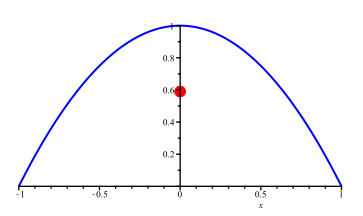
Funktion kuvaajalla \(y=f(x)=1-x^2\) on
\[ds=\sqrt{1+f'(x)^2}\, dx=\sqrt{1+4x^2}\, dx.\]
Paraabelin kaaren pituus on siis
\[\ell =\int_C1\, ds =2\int_0^1\sqrt{1+4x^2}\, dx = \sqrt{5}+\frac{1}{2}\ln(2+\sqrt{5})
\approx 2{,}958;\]
integraalin voi laskea (Maplella tai) sijoituksella \(x=\frac12\sinh t\), jolloin
\[1+4x^2= 1+\sinh^2 t =\cosh^2 t.\]
Koska
\[\begin{array}{rcl}
Y=\int_C y\, ds &=&
\int_{-1}^1(\underbrace{1-x^2}_{=y})\underbrace{\sqrt{1+(2x)^2}\, dx}_{=ds}\approx 1{,}745,
\end{array}\]
niin
\[\overline{y}= \frac{Y}{\ell} \approx 0{,}59.\]
Tehtävä:Keksi tilanteita, joissa paraabelin kaari (3-ulotteiden avaruuden
osajoukoksi tulkittuna) pysyy sopivasti tuettuna tasapainossa.